

Forget Hosier Lane! Despite the gritty, graffitied address being one of Australia’s most photographed attractions, Robyn Annear doesn’t rate it.
The author nominates skinny little Lang Lane, off Bourke Street, as her favourite Melbourne hideaway. It may not make a great selfie, but it does make a great story, which is the Castlemaine-based historian’s chief trade.
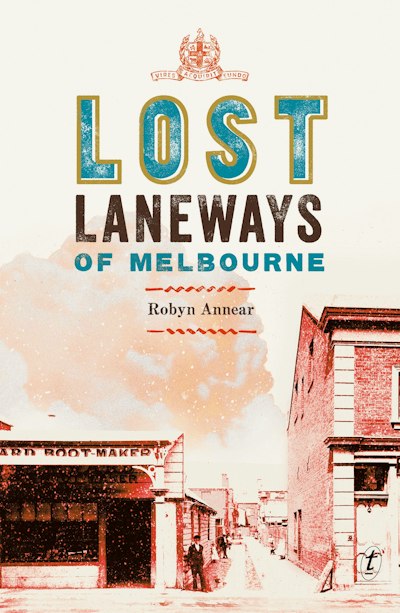
Robyn’s 11th and latest book, Lost Laneways of Melbourne, is the result of following her nose down such rights of way.
“I guess I just wanted to understand why laneways are having such a moment,” she says.
“They were overlooked for so long and now they’re iconic – the most photographed things among Melbourne visitors. So, I really wanted to understand if there was anything in that, or if it was just a construction of the Instagram age, where ‘authenticity’, in inverted commas, is everything.”
Robyn says she’d always assumed the laneways came into being following the gold rushes, when Melbourne expanded in a hurry and had to squeeze more people in.
“But I discovered nearly all of them were in existence before that,” she says. (Almost 200 of them.)
“No sooner had Mr. Huddle drawn up his rigid, impermeable grid, the laneways began to subvert it.”
Each had their own character, and characters, which Robyn explores in the book. Lang Lane, formerly Shamrock Alley, was home to at least 150 people by the mid-1850s, when it was condemned as “the most thickly crowded and worst drained of any part of Melbourne”.
Robyn writes of this “purlieu of pollution” being the site where suspected smallpox festered, a newborn was abandoned, a woman was knocked out with a beef bone, and the cottages were more commonly called hovels.
Lost Laneways of Melbourne brings to life the little people who called these places home, and the movers and shakers who set out the city in its earliest days. It’s part history book/part tour guide, encouraging readers to literally take a walk in Robyn’s footsteps.
The author stepped out many kays during the writing. She trawled historical news articles via Trove, tooled about street view maps and made friends in Spatial Services at the City of Melbourne to stitch fragments of social history and raw facts into a cracking narrative.
There’s the story, which covers the “crazing of Melbourne’s grid” and ultimately the resurrection of the laneways and their folk, and then there’s the telling. Which is done in Robyn’s trademark engaging style. It’s quirky, nimble and lots of fun. It’s a contemporary telling of history that’s also sympathetic to the times and social challenges it represents.
Robyn has been looting history in this way since 1995, with the publication of Bearbrass: Imagining early Melbourne.
“I started by writing what I would have wanted to read,” she says of her energetic and slightly mischievous way with words.
“I was writing for me in the first instance and making the assumption that there might be other people who would enjoy it too.”
In 1999, Nothing But Gold: The diggers of 1852, gave a new view of local goldfields history.
Robyn says while there were plenty of books full of great information about the local rush, she “wanted to try and capture the sounds and the smells as well as the sites of the goldfields”.
“I wanted to try and capture the sensation of being there, because it must have been so exciting for those people who’d ventured on a whim from the other side of the world – and disappointing – all the feelings. For them to take that chance, it tells you something about what they were leaving behind.”
Subsequent titles took her back to metro Melbourne to explore the colourful histories of buildings, streets, corners and photographic archives.
The experience of writing about Melbourne’s laneways has given Robyn a different perspective on Hosier Lane, as not just a flash-in-the-pan Instagram craze, but as part of the recognition that Melbourne has always been a city of lanes.
“I think it’s great because it means that the City of Melbourne, which is the steward of the lanes, takes them that much more seriously and is more inclined to protect them against incursions and the loss of even more of them,” she says.
Robyn hopes her book also adds to the upsurge of appreciation.
“For me I would like to see developers told, if you want to build where that laneway is, you have to build around it and respect the shape and the form of it and do something creative, because that’s part of the city you’re building in.
“I’m not the world’s greatest preservationist, but I just think the laneways are so integral to Melbourne. If I can further that message, then that’s great.”
Robyn will speak about her book at Castlemaine Library on December 3 and Gisborne Library on December 9.
Book for Gisborne, or join the waitlist in Castlemaine.
– LAUREN MITCHELL